

50 years of community development on Cape Breton
Cape Breton Post, June 3, 2026

An innovative solution to a pressing community need for individuals living with mental illness and in need of supportive housing options.
SHIMI (Supported Housing for Individuals with Mental Illness) is an innovative solution to a pressing community need for individuals who are living with mental illness and in need of supportive housing options. The project provides high quality, secure and independent housing together with a range of responsive supports to adults living with, and recovering from, a mental illness.
Persons living with mental illness are frequently marginalized and vulnerable, and struggle to find decent housing at an affordable cost. Many live in substandard apartments, partly because of the dynamic of private sector market rent levels and partly because of the shelter allowances provided by the Provincial Income Assistance Program. They are often shunned because of the visible signs of poverty, the presentation of symptoms, and the general misconceptions that many have about mental illness (propensity to violence, irrational actions and or beliefs, criminal intent associated with drug use, etc).
Suitable apartments and associated utilities that can be afforded under the shelter allowance portion of income assistance are rare. Apartments that rent for appreciably less than this generally have some compelling reason that they cannot command average market rent. Principally this will be because of their physical condition or because of their location.
Individuals living with or recovering from mental illness frequently experience housing insecurity (couch surfing), substandard accommodations, low income and social exclusion.
While successfully confronting any one of these issues would be a challenge, combined they can lead to a poor quality of life. The risk of homelessness is high.
The SHIMI model follows the practice of integrating small numbers of apartments seamlessly and unobtrusively into the community. The housing is secure both in the physical sense and in the financial sense:
Physical Security
The apartments and buildings are finished to a mid-market standard and professional property management ensures that the rent is collected, the bills paid and quality standards are maintained.
Financial Security
All shelter costs (rent, heat, power, water) are included for a rent of $535 per month. This is the maximum shelter allowance available to single individuals through the Province of Nova Scotia’s Income Assistance Program. Fixing the rent at the maximum shelter component ensures that the balance of an individual’s income can be used for food, clothing, transportation, etc.
Furnishings
Through the generosity of the Mental Health Foundation of Nova Scotia and the Cape Breton Mental Health Foundation, each new apartment is furnished with a full suite of furniture and appliances, including a washer and dryer.


Our Safe Spaces policy ensures a respectful, supportive atmosphere for everyone. We pledge to listen, learn, and adapt to your needs, because your well-being is our priority. Together, we will create a safer, compassionate community for all.
As a member of the non-profit New Dawn Enterprises family, all profits generated are reinvested back into our community to support programs such as New Dawn Meals on Wheels which delivers over 20,000 meals annually to those in need. Clients of New Dawn are indirectly supporting our community and for that, we thank you for choosing us!

Emergency temporary shelter for those who are unhoused or at risk of homelessness

Supportive, level-one residential care facility for people with disabilities
See all Our Work
| Title | Schedule | Wage/Salary | Status |
|---|---|---|---|
|
No current job postings in SHIMI |
|||
Cape Breton Post, June 3, 2026

“Organizations like New Dawn — that are tangibly carving out a different way — are needed more than ever.”
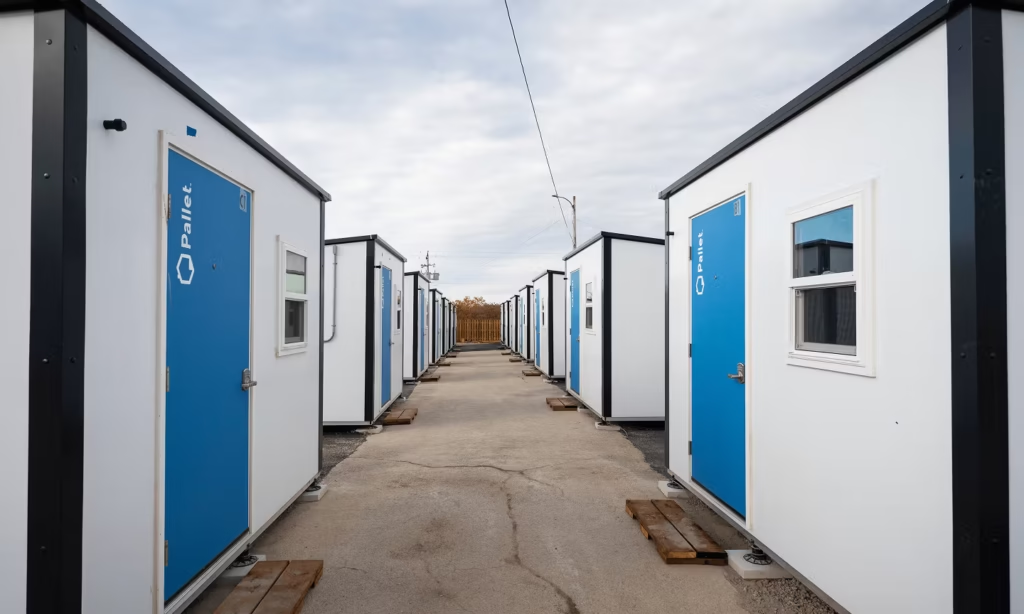
New kinds of mini homes are multiplying across the country to take on the housing crisis
New Dawn Enterprises
37 Nepean St, Sydney, Nova Scotia B1P 6A7
newdawn@newdawn.ca
902-539-9560
Join 3,000+ readers and get news from New Dawn Enterprises in your inbox.
Eymu’ti’k Unama’ki, newte’jk l’uiknek te’sikl Mi’kmawe’l maqamikall mna’q iknmuetumittl. Ula maqamikew wiaqi-wikasik Wantaqo’tie’l aqq I’lamatultimkewe’l Ankukamkewe’l Mi’kmaq aqq Eleke’wuti kisa’matultisnik 1726ek.
We are in Unama’ki, one of the seven traditional and unceded ancestral territories of the people of Mi’kma’ki. This territory is covered by the Treaties of Peace and Friendship which the Mi’kmaq first signed with the British Crown in 1726.
Ketu’-keknuite’tmek aqq kepmite’tmek ula tela’matultimkip wjit maqamikew ta’n etekl mtmo’taqne’l. Ula tett, ula maqamikek, etl-lukutiek l’tunen aqq apoqntmnen apoqnmasimk aqq weliknamk Unama’ki.
We wish to recognize and honour this understanding of the lands on which we reside. It is from here, on these lands, that we work to create and support a culture of self-reliance and vibrancy.