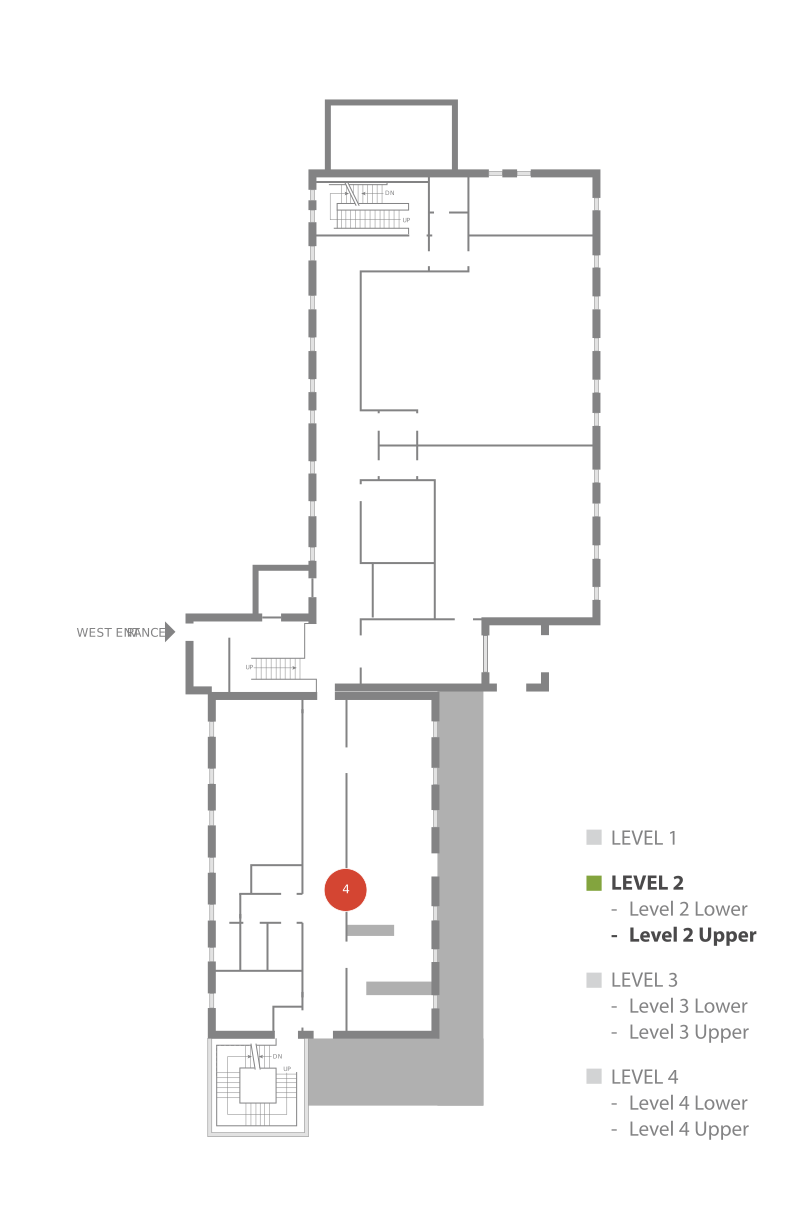
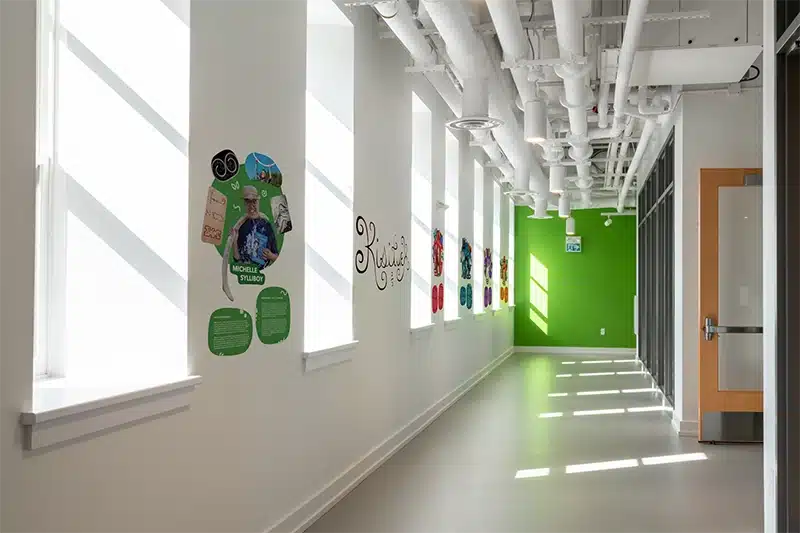



You are standing before the Elders Wall, a tribute to the Eltuek Elders whose care, generosity of spirit, and vision continue to shape this building and its purpose. The Elders guided the creation of Kisituek (meaning, “we have made it together”, in Mi’kmaq), a vibrant installation that celebrated the artistry, strength, and spirit of local Mi’kmaw creators. Kisituek now lives on as a digital installation within this self-guided tour, extending its reach and resonance beyond gallery walls. Through this continuation, the conversations and connections sparked by Kisituek remain active, inviting all who visit to listen, reflect, and take part in what has been made together.
- English
- French
KISITUEK
a Mi’kmaw word meaning we have made it (together)
it has been made by L’nu hands, hearts, and minds
the creation of art, craft, song, and tradition
Here, we honour the accomplished work and lives of the Kisituek Gallery artists Loretta Gould, Nancy Oakley, Michelle Sylliboy, Lee Cremo, Sarah Denny, and Morningstar.
Each artist is deeply embedded in their community, distinguished in their chosen artistic path, and has far-reaching influence and impact that echoes through generations.
Eltuek Elders
Ernest Johnson, Eskasoni
Pauline Isadore, Wagmatcook
Lawrence Wells, Membertou
Dolena Poulette, We’koqma’q
Anita Basque, Potlotek
We would like to thank the Eltuek Elder Advisors for their integrity and unwavering excitement to see the Kisituek Gallery come to life, beginning with conversations in 2019, through the call for nominations, the review and design process, and the celebration of these magnificent artists.
Wela’liek, Thank you.
Credits
The Kisituek Gallery was designed by Patuo’kn Illustration and Design, an Indigenous-led creative studio based in Unama’ki, Cape Breton Island. Led by designers Kassidy Bernard and Kaylyn Bernard, Patuo’kn brought care, cultural knowledge, and visual storytelling to the creation of the gallery’s didactic panels and overall design. Their work has been instrumental in shaping a space that honours Mi’kmaw artists, fosters connection, and invites reflection.

New Dawn Enterprises and Eltuek Arts Centre recognize the support of the Province of Nova Scotia through the Department of Communities, Culture, Tourism & Heritage. We are pleased to work in partnership with the Culture Division to develop and promote our cultural resources for all Nova Scotians.
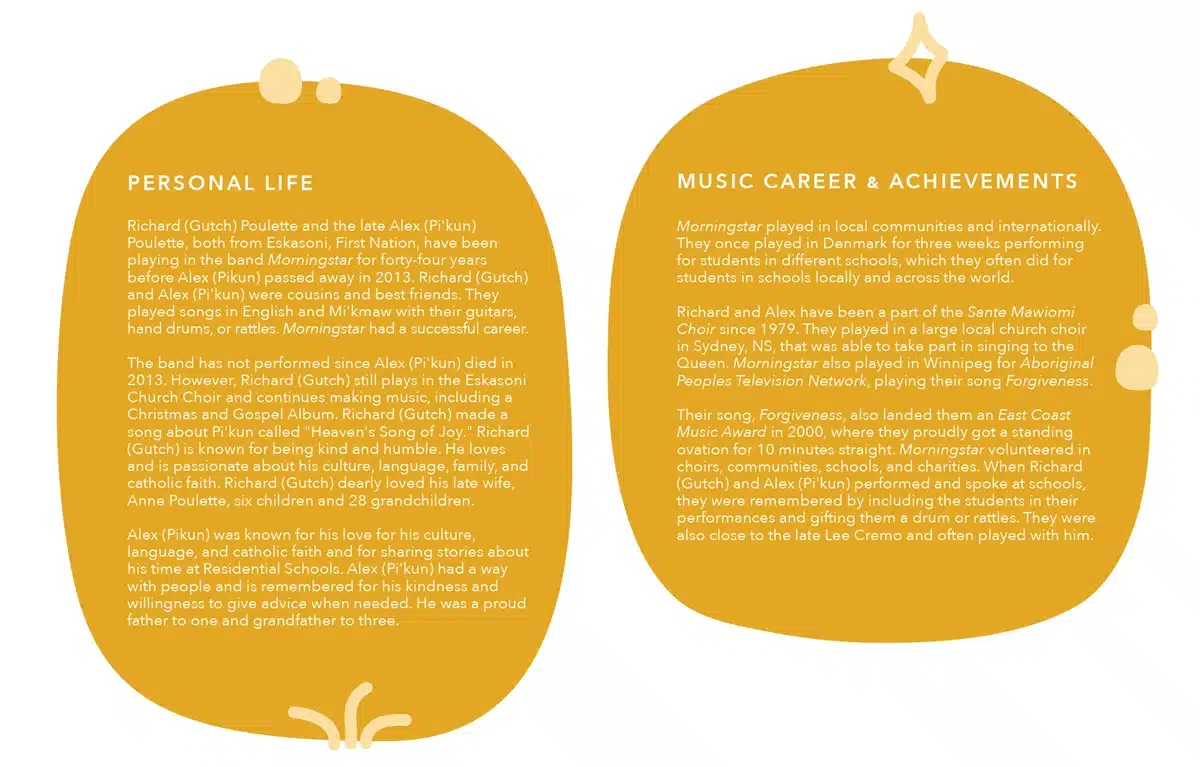
Alex & Richard Poulette – Morningstar
Cousins, best friends, and lifelong collaborators, Richard (Gutch) Poulette and the late Alex (Pi’kun) Poulette, both from Eskasoni First Nation, formed the heart of Morningstar—a beloved musical duo that performed together for 44 years until Pi’kun’s passing in 2013. Singing in both English and Mi’kmaq, they brought powerful messages of healing, culture, and faith through their music, using guitars, hand drums, and rattles to create their distinctive sound.
Though Morningstar has not performed since 2013, Gutch continues to share his love of music through the Eskasoni Church Choir and through new projects, including a Christmas and Gospel album. One of his most personal pieces, Heaven’s Song of Joy, was written in memory of Pi’kun. Known for his humility and gentle spirit, Gutch carries forward a deep passion for Mi’kmaw culture, language, family, and Catholic faith.
Pi’kun is remembered not only for his musical talent but also for his generosity of spirit. He shared stories of his experiences at Residential Schools, offered guidance to those who sought it, and held strong to his identity as a Mi’kmaw man of faith. He was deeply loved by his family and community.
Morningstar performed locally and internationally, including a three-week tour in Denmark where they visited schools to perform and connect with youth—something they often did back home as well. Their performances were interactive and generous, often leaving students with the gift of a drum or rattle to continue the rhythm themselves.
The duo were longtime members of the Sante Mawiomi Choir (since 1979) and contributed to a large Mi’kmaw church choir in Sydney, NS, which once had the honour of singing for Queen Elizabeth II. They also performed on the Aboriginal Peoples Television Network (APTN) in Winnipeg, where their original song Forgiveness was featured.
Forgiveness earned Morningstar an East Coast Music Award in 2000 and a 10-minute standing ovation—a testament to the impact of their message and music. Throughout their careers, Gutch and Pi’kun volunteered their time and talent in choirs, schools, community events, and charitable causes, often performing alongside their close friend, the late Lee Cremo.
Their music, rooted in culture, spirituality, and kinship, continues to resonate—carried forward through memory, song, and the deep connections they forged wherever they went.
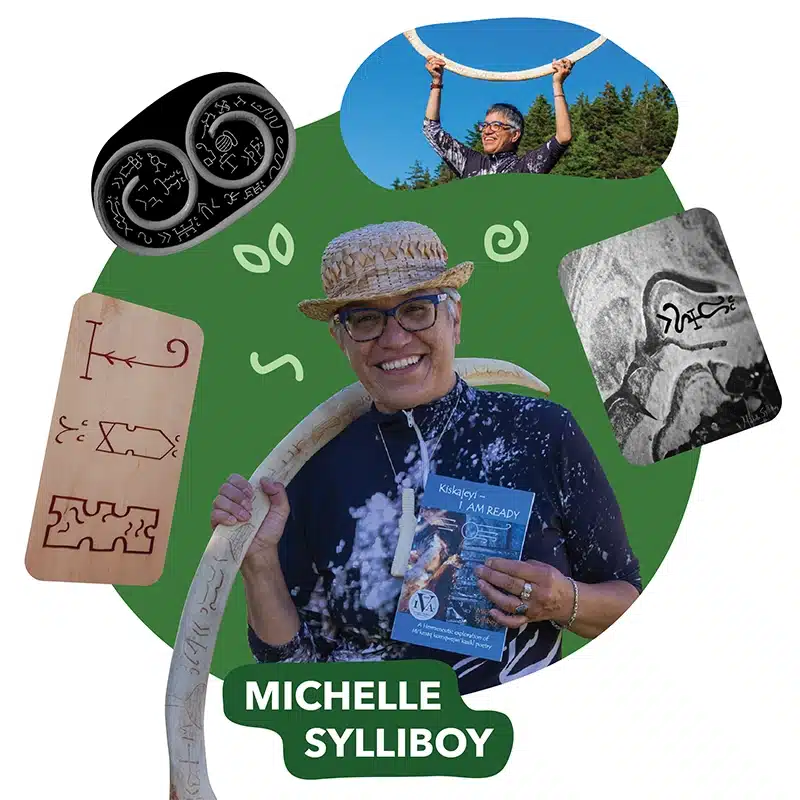
Michelle Sylliboy
Michelle Sylliboy is a two-spirited L’nu artist from We’koqma’q, born in Boston, Massachusetts. Since the mid-1990s, Michelle has built a multidisciplinary art practice spanning photography, digital media, poetry, and performance. A central focus of the work is the revitalization of Mi’kmaw hieroglyphs and language, offering creative ways for L’nuwey youth and communities to reconnect with their linguistic and cultural heritage.
Michelle’s artistic journey has been shaped by time spent in Aotearoa (New Zealand), where learning jade and bone carving from Māori artists deeply influenced both process and perspective. That exchange of Indigenous knowledge systems continues to inform the work today.
Michelle is the author of Kiskajeyi – I Am Ready, a collection of photographs and L’nuk hieroglyphic poetry, which received the 2020 Indigenous Voices Award. Further recognition includes the 2021 Indigenous Artist Recognition Award from Arts Nova Scotia, and a long-list nomination for the 2022 Sobey Art Award.
Currently completing a Ph.D. in the Philosophy of Education at Simon Fraser University, Michelle’s research centres on the artistic expression of komqwejwi’kasikl—the Mi’kmaw hieroglyphic writing system. Most recently, Michelle launched Komqwejwi’kasikl Clothing, a fashion line that brings Mi’kmaw language into everyday spaces through wearable art.
Nancy Oakley
Nancy Oakley is a Mi’kmaq and Wampanoag artist living and working in Eskasoni, with ancestral roots in Mashpee, Massachusetts. A dedicated mother, grandmother, and cultural knowledge keeper, Nancy draws deeply from her lived experiences as a woman, parent, and community member. Her work spans photography, basketry, beading, and traditional pottery, centering on the revitalization and transmission of Mi’kmaw cultural knowledge through craft.
Nancy’s artistic journey has taken her across Turtle Island in pursuit of deeper understanding and practice. She studied at the Institute of American Indian Arts (IAIA) in Santa Fe, New Mexico, where she earned an Associate of Fine Arts degree in photography and ceramics. Her education continued at NSCAD University and the University College of Cape Breton (UCCB), focusing on museum studies and Mi’kmaw cultural heritage preservation. Nancy has been mentored by respected artists including Richard Zane Smith in traditional pottery and Peter and Pauline Poulette in black ash basketry.
Working with materials such as smoke, fire, sweetgrass, clay, mussel shells, beads, spruce tips, seaweed, and black ash, Nancy creates tactile and powerful pieces that honour tradition while engaging with contemporary practice. Her process is grounded in land-based knowledge, cultural continuity and environmental respect. Reviving Mi’kmaw traditions of open fire, stone polishing, braiding sweetgrass, and harvesting from the land has been an important part of her education and practice.
Nancy shares her knowledge, craft, and rich experience with so many, and works hard to share her voice for the artist community and Indigenous artists. She received the Queen Elizabeth II’s Platinum Jubilee Medal in 2023 and was named Indigenous Crafter of the Year in 2018. She has served on the boards of Craft Nova Scotia, Craft Alliance, Mawi’art, the Creative Nova Scotia Leadership Council, and Eltuek Arts Centre, and she continues to advocate for Indigenous artists and craft communities across the region.
Through her art and leadership, Nancy Oakley strengthens the vital connections between land, tradition, and future generations—embodying the role of artist as caretaker, mentor, and bridge between worlds.
Lee Cremo (1938–1999)
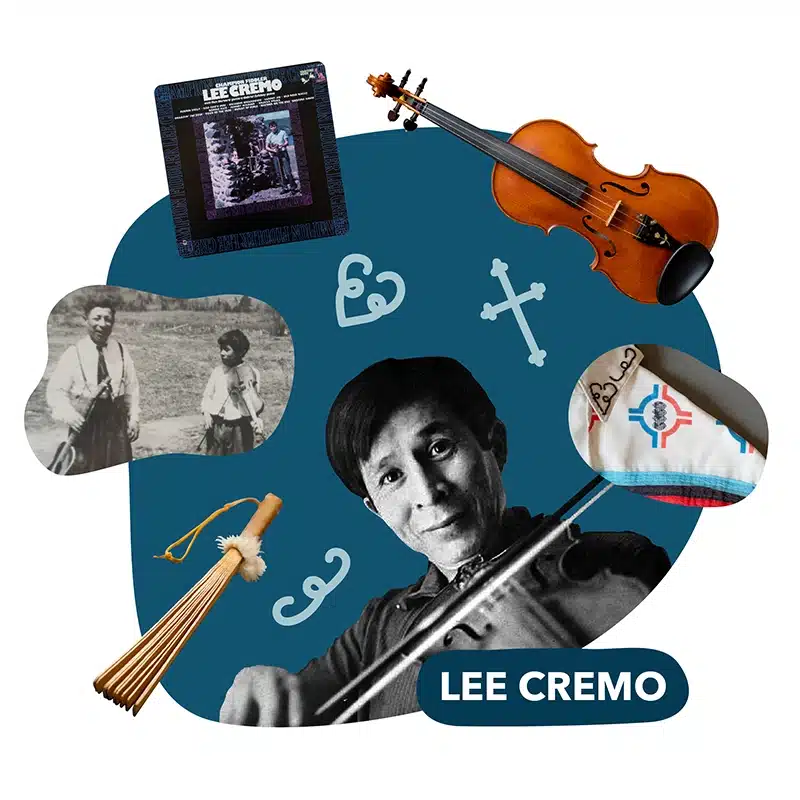
Lee Cremo was a folk hero and legendary fiddler from Unama’ki, Cape Breton Island, celebrated for his extraordinary musicianship, deep cultural pride, and generous spirit. A beloved father and grandfather, Lee was widely regarded as one of the finest fiddlers to emerge from the Cape Breton tradition, and one of the most well-known Mi’kmaw musicians in the Maritimes. He performed extensively with his ensemble, The Eastern Variation, captivating audiences with his dynamic style and unmistakable presence.
Though he worked as a bus driver by trade, Lee’s true vehicle was music—driving joy, laughter, and cultural pride wherever he went. Known in his community and beyond for his humour, kindness, humility, and generosity, Lee’s passion for Mi’kmaw culture, language, and dance was unwavering. He performed at weddings, ceilidhs, dances, funerals, telethons, and fundraisers, and mentored countless young musicians, always encouraging the next generation.
Raised in Eskasoni, Lee was surrounded by music from an early age. His father, Simon Cremo, was a fiddler, and music filled their home. Lee began on guitar before taking up the fiddle, learning from both his father and renowned Cape Breton fiddlers such as Winston “Scotty” Fitzgerald and Dan Hughie MacEachern. His style was electric—fusing traditional Mi’kmaw melodies with Cape Breton and Scottish influences to create a sound that was distinctly his own. His performances radiated joy, rhythm, and soul, energizing fellow musicians and audiences alike.
Lee Cremo’s legacy is etched into the fabric of Canadian music history. In 1968, he released his first album, Champion Fiddler, and appeared on the cover of the inaugural issue of Cape Breton Magazine. He was a six-time winner of the Maritime Old Time Fiddling Contest and received over 80 awards throughout his career. His accolades include the prestigious Best Bow Arm in the World award at the Grand Master Fiddling Championship in Nashville.
He performed for Queen Elizabeth II at Expo 67, was featured in the acclaimed NFB documentary Arm of Gold, and played at the national launch of the Aboriginal Peoples Television Network (APTN). In 1996, he received the East Coast Music Award for Aboriginal Recording of the Year.
More than a master fiddler, Lee Cremo was a cultural ambassador, mentor, and storyteller. His music lives on in the hearts of those who heard him play and in the hands of the many he inspired.
Sarah Denny
Sarah Denny, originally from Potlotek First Nation and a long-time resident of Eskasoni, was a trailblazer in the revitalization of Mi’kmaw language, dance, and song. For over 60 years, she dedicated her life to preserving and sharing L’nu culture through performance, education, and ceremony.
Her passion for cultural revitalization began with teaching traditional Mi’kmaw dance, song, and chants—art forms that had been suppressed or lost due to colonization. Sarah believed deeply in the power of culture to heal and to connect generations. Her work led to the creation of the Denny Family Dance Group, which included her children and grandchildren, and later evolved into the Eskasoni Mi’kmaq Dancers. Through these groups, she taught youth how to sing, pray, and dance in L’nu ways.
Sarah’s contributions were recognized at the national level. She was acknowledged by Grand Chief George Erasmus and the National Indian Brotherhood (now the Assembly of First Nations) for her outstanding efforts in preserving Indigenous languages. One of her most meaningful projects was the development of the Mi’kmaq Hymnal Kit, blending her Christian faith with Mi’kmaw teachings in a way that resonated across generations. She also founded the Eskasoni Noel R. Denny Memorial Powwow, presented at conferences and national events, and appeared in numerous films, radio interviews, and public engagements. Her work inspired countless others to explore and embrace Mi’kmaw identity, history, and tradition.
Sarah held the role of the first Mi’kmaq Cultural Officer with the Mi’kmaq Association of Cultural Studies for three decades. Her knowledge of language, ceremony, dance, and traditional Mi’kmaw medicines—passed down from her grandmother, Julia Nevin—became a vital source of learning for youth and community members across Mi’kma’ki.
L’nu communities will remember Sarah for being humble and kind, an exceptional woman who taught her family and community of Eskasoni about culture and language. Mi’kmaw people have chants and songs today because of Sarah’s dedication and willingness to share what she learned.
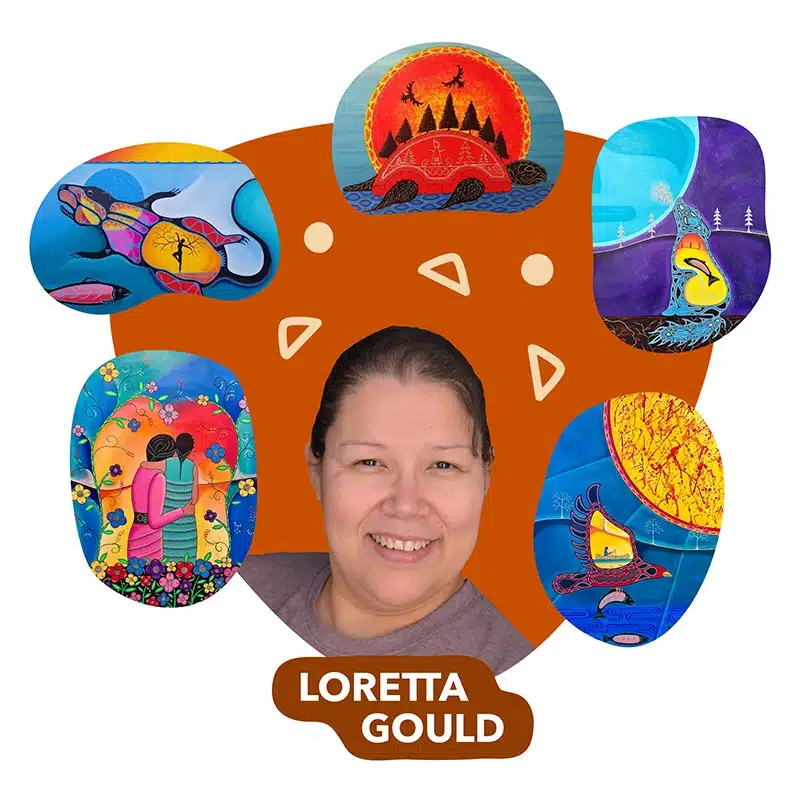
Loretta Gould
“Being an artist wasn’t one of my dreams as a child, but being in the arts was. Art has been so good to me—it is educational, inspirational, emotional, and very therapeutic. I paint what I feel. So, I hope people feel the way I do when I’m painting when they look at my work. I am happy that I can express my feelings through art. I hope one day my artwork will inspire someone to be an artist.”
Loretta Gould is a self-taught Mi’kmaw painter and quilter from We’koqma’q First Nation, celebrated for her vibrant use of colour and expressive imagery. A mother of six, Loretta first made a living through quilting. When her sewing machine broke in 2013, she picked up a paintbrush and has been painting ever since. For her, art is a way to get her spiritual feelings on canvas. Her art reflects a profound love for family, culture, and faith.
Loretta’s Seven Sacred Teachings series—Love, Courage, Wisdom, Humility, Truth, Honesty, and Respect—is a powerful visual expression of these guiding values. Each piece offers a deeply personal narrative, filled with sacred symbols, rich landscapes, and spiritual figures. Her storytelling through paint brings together lived experience, memory, and hope.
Her work has reached audiences internationally, with original paintings sold and exhibitions shown across Mi’kma’ki and beyond. She has also illustrated Mi’kmaw language children’s books such as Mi’kmaw Moons: The Seasons in Mi’kma’ki and Mawkiljemk Mi’kmawituk / Counting in Mi’kmaw, supporting cultural and language revitalization.
Visitors can experience Loretta’s work in person in the permanent installation of Seven Sacred Teachings on the 3U (Upper) level of the Eltuek Arts Centre. Her mural honouring Eleanor Young can also be seen outside Eleanor’s Court at 95 Charlotte Street, Sydney, NS. Through every brushstroke, Loretta continues to share stories of healing, connection, and cultural pride.
KISITUEK
un mot micmac qui signifie nous l’avons fait (ensemble)
il a été fait par les mains, les cœurs et les esprits L’nu
la création d’art, d’artisanat, de chanson et de tradition
Nous rendons ici hommage au travail accompli et à la vie des artistes de la Kisituek Gallery: Loretta Gould, Nancy Oakley, Michelle Sylliboy, Lee Cremo, Sarah Denny et Morningstar.
Chaque artiste est profondément ancré dans sa communauté, se distingue par la voie artistique qu’il a choisie et exerce une influence et un impact considérables qui se répercutent sur plusieurs générations.
Seniors d’Eltuek
Ernest Johnson, Eskasoni
Pauline Isadore, Wagmatcook
Lawrence Wells, Membertou
Dolena Poulette, We’koqma’q
Anita Basque, Potlotek
Nous tenons à remercier les conseillers seniors Eltuek pour leur intégrité et leur enthousiasme inébranlable à l’idée de voir la Kisituek Gallery prendre vie, en commençant par des conversations en 2019, en passant par l’appel à candidatures, le processus d’examen et de conception, et la célébration de ces magnifiques artistes.
Wela’liek, merci.
Crédits
La Kisituek Gallery a été conçue par Patuo’kn Illustration and Design, un studio de création autochtone basé à Unama’ki, sur l’île du Cap-Breton. Dirigé par les concepteurs Kassidy Bernard et Kaylyn Bernard, Patuo’kn a apporté son attention, ses connaissances culturelles et ses récits visuels à la création des panneaux didactiques de la galerie et à sa conception générale. Leur travail a contribué à façonner un espace qui rend hommage aux artistes Micmacs, favorise les liens et invite à la réflexion.

New Dawn Enterprises et Eltuek Arts Centre reconnaissent le soutien de la province de la Nouvelle-Écosse par l’intermédiaire du ministère des Communautés, de la Culture, du Tourisme et du Patrimoine. Nous sommes heureux de travailler en partenariat avec la Division de la culture pour développer et promouvoir nos ressources culturelles pour tous les Néo-Écossais.
Alex & Richard Poulette – Morningstar
Cousins, meilleurs amis et collaborateurs de toujours, Richard (Gutch) Poulette et feu Alex (Pi’kun) Poulette, tous deux originaires de la Première nation d’Eskasoni, ont formé le cœur de Morningstar – un duo musical bien-aimé qui s’est produit ensemble pendant 44 ans, jusqu’au décès de Pi’kun en 2013. Chantant en anglais et en micmac, ils ont transmis de puissants messages de guérison, de culture et de foi à travers leur musique, utilisant des guitares, des tambours à main et des hochets pour créer leur son distinctif.
Bien que Morningstar ne se soit pas produit depuis 2013, Gutch continue de partager son amour de la musique par l’intermédiaire de la Eskasoni Church Choir et de nouveaux projets, dont un album de Noël et de gospel. L’un de ses morceaux les plus personnels, Heaven’s Song of Joy, a été écrit à la mémoire de Pi’kun. Connu pour son humilité et sa douceur d’esprit, Gutch nourrit une profonde passion pour la culture, la langue, la famille et la foi catholique des Micmacs.
On se souvient de Pi’kun non seulement pour son talent musical, mais aussi pour sa générosité d’esprit. Il racontait ses expériences dans les pensionnats, donnait des conseils à ceux qui en demandaient et restait fermement attaché à son identité d’homme de foi micmac. Il était profondément aimé de sa famille et de sa communauté.
Morningstar s’est produit localement et à l’étranger, notamment lors d’une tournée de trois semaines au Danemark, où ils se sont rendus dans des écoles pour jouer et entrer en contact avec les jeunes – ce qu’ils faisaient souvent dans leur pays. Leurs spectacles étaient interactifs et généreux, laissant souvent aux élèves un tambour ou un hochet en cadeau pour qu’ils continuent le rythme eux-mêmes.
Le duo est membre de longue date de la Sante Mawiomi Choir (depuis 1979) et a contribué à la grande chorale de l’église micmaque de Sydney (Nouvelle-Écosse), qui a eu l’honneur de chanter pour la reine Elizabeth II. Ils se sont également produits sur le Réseau de télévision des peuples autochtones (APTN) à Winnipeg, où leur chanson originale Forgiveness a été présentée.
Forgiveness a valu à Morningstar un East Coast Music Award en 2000 et une ovation de 10 minutes, ce qui témoigne de l’impact de leur message et de leur musique. Tout au long de leur carrière, Gutch et Pi’kun ont consacré leur temps et leur talent à des chorales, des écoles, des événements communautaires et des causes caritatives, se produisant souvent aux côtés de leur ami proche, le feu Lee Cremo.
Leur musique, enracinée dans la culture, la spiritualité et les liens de parenté, continue de résonner, portée par la mémoire, la chanson et les liens profonds qu’ils ont tissés partout où ils sont allés.
Michelle Sylliboy
Michelle Sylliboy est une artiste L’nu à deux esprits, originaire de We’koqma’q, née à Boston, dans le Massachusetts. Depuis le milieu des années 1990, Michelle a développé une pratique artistique multidisciplinaire couvrant la photographie, les médias numériques, la poésie et la performance. La revitalisation des hiéroglyphes et de la langue micmaque est au cœur de son travail, offrant aux jeunes et aux communautés L’nuwey des moyens créatifs de renouer avec leur patrimoine linguistique et culturel.
Le parcours artistique de Michelle a été façonné par le temps passé à Aotearoa (Nouvelle-Zélande), où l’apprentissage du jade et de la sculpture sur os auprès d’artistes Māori a profondément influencé à la fois le processus et la perspective. Cet échange de systèmes de connaissances indigènes continue d’influencer son travail aujourd’hui.
Michelle est l’auteure de Kiskajeyi – I Am Ready, un recueil de photographies et de poèmes hiéroglyphiques L’nuk, qui a reçu le prix Indigenous Voices en 2020. Elle a également reçu le prix de reconnaissance des artistes indigènes 2021 décerné par Arts Nova Scotia et a été nominée sur la longue liste du prix Sobey Art 2022.
Michelle termine actuellement un doctorat en philosophie de l’éducation à l’Université Simon Fraser. Ses recherches portent sur l’expression artistique du komqwejwi’kasikl, le système d’écriture hiéroglyphique des Micmacs. Plus récemment, Michelle a lancé Komqwejwi’kasikl Clothing, une ligne de vêtements qui introduit la langue micmaque dans les espaces quotidiens par le biais de l’art vestimentaire.
Nancy Oakley
Nancy Oakley est une artiste micmaque et wampanoag qui vit et travaille à Eskasoni, avec des racines ancestrales à Mashpee, dans le Massachusetts. Mère, grand-mère et gardienne du savoir culturel, Nancy puise profondément dans son expérience de femme, de parent et de membre de la communauté. Son travail englobe la photographie, la vannerie, le perlage et la poterie traditionnelle, et se concentre sur la revitalisation et la transmission du savoir culturel micmac par le biais de l’artisanat.
Le parcours artistique de Nancy l’a menée à travers l’île de la Tortue à la recherche d’une compréhension et d’une pratique plus approfondies. Elle a étudié à l’Institute of American Indian Arts (IAIA) de Santa Fe, au Nouveau-Mexique, où elle a obtenu un diplôme d’associée des beaux-arts en photographie et en céramique. Elle a poursuivi sa formation à l’université NSCAD et à l’University College of Cape Breton (UCCB), en se concentrant sur les études muséales et la préservation du patrimoine culturel micmac. Nancy a été encadrée par des artistes respectés, notamment Richard Zane Smith pour la poterie traditionnelle et, Peter et Pauline Poulette pour la vannerie de frêne noir.
Travaillant avec des matériaux tels que la fumée, le feu, le foin d’odeur, l’argile, les coquilles de moules, les perles, les pointes d’épicéa, les algues et le frêne noir, Nancy crée des pièces tactiles et puissantes qui honorent la tradition tout en s’engageant dans la pratique contemporaine. Son processus est fondé sur la connaissance de la terre, la continuité culturelle et le respect de l’environnement. Faire revivre les traditions micmaques du feu ouvert, du polissage des pierres, du tressage du foin d’odeur et de la récolte de la terre a constitué une part importante de sa formation et de sa pratique.
Nancy partage ses connaissances, son savoir-faire artisanal et sa riche expérience avec un grand nombre de personnes, et s’efforce de faire entendre la voix de la communauté des artistes et des artistes indigènes. Elle a reçu la Médaille du jubilé de platine de la Reine Elizabeth II en 2023 et a été nommée Artiste autochtone de l’année en 2018. Elle a siégé aux conseils d’administration de Craft Nova Scotia, de Craft Alliance, de Mawi’art, du Creative Nova Scotia Leadership Council et du Eltuek Arts Centre, et elle continue de défendre les artistes autochtones et les communautés d’artisans de toute la région.
Par son art et son leadership, Nancy Oakley renforce les liens vitaux entre la terre, la tradition et les générations futures – incarnant le rôle de l’artiste en tant que gardien, mentor et pont entre les mondes.
Lee Cremo (1938–1999)
Lee Cremo était un héros folklorique et un violoneux légendaire d’Unama’ki, sur l’île du Cap-Breton, célébré pour son extraordinaire talent de musicien, sa profonde fierté culturelle et son esprit généreux. Père et grand-père bien-aimé, Lee était largement considéré comme l’un des meilleurs violoneux issus de la tradition du Cap-Breton et l’un des musiciens micmacs les plus connus des Maritimes. Il s’est beaucoup produit avec son ensemble, The Eastern Variation, captivant le public par son style dynamique et sa présence inimitable.
Bien qu’il ait été chauffeur de bus de métier, le véritable véhicule de Lee était la musique – apportant joie, rire et fierté culturelle partout où il allait. Connu dans sa communauté et au-delà pour son humour, sa gentillesse, son humilité et sa générosité, Lee avait une passion inébranlable pour la culture, la langue et la danse micmaque. Il s’est produit lors de cérémonies de mariage, de ceilidhs, de danses, de funérailles, de téléthons et de collectes de fonds, et a été le mentor d’innombrables jeunes musiciens, encourageant toujours la prochaine génération.
Élevé à Eskasoni, Lee a été entouré de musique dès son plus jeune âge. Son père, Simon Cremo, était violoneux et la musique remplissait leur maison. Lee a commencé à jouer de la guitare avant de se mettre au violon, apprenant de son père et de violoneux renommés du Cap-Breton tels que Winston « Scotty » Fitzgerald et Dan Hughie MacEachern. Son style était électrique – il fusionnait les mélodies traditionnelles micmaques avec des influences cap-bretonnes et écossaises pour créer un son qui lui était propre. Ses interprétations rayonnaient de joie, de rythme et d’âme, énergisant ses collègues musiciens et le public.
L’héritage de Lee Cremo est gravé dans le tissu de l’histoire de la musique canadienne. En 1968, il a sorti son premier album, Champion Fiddler, et a fait la couverture du premier numéro du Cape Breton Magazine. Il a remporté six fois le Maritime Old Time Fiddling Contest et a reçu plus de 80 prix tout au long de sa carrière. Il a notamment reçu le prestigieux prix du Best Bow Arm in the World (meilleur bras d’archet au monde) lors du Grand Master Fiddling Championship à Nashville.
Il s’est produit devant la Reine Elizabeth II à l’Expo 67, a figuré dans le documentaire acclamé de l’ONF Arm of Gold et a joué lors du lancement national du Réseau de télévision des peuples autochtones (APTN). En 1996, il a reçu le East Coast Music Award pour l’Aboriginal Recording of the Year (enregistrement autochtone de l’année).
Plus qu’un maître violoneux, Lee Cremo était un ambassadeur culturel, un mentor et un conteur. Sa musique vit dans le cœur de ceux qui l’ont entendu jouer et dans les mains des nombreuses personnes qu’il a inspirées.
Sarah Denny
Sarah Denny, originaire de la Première nation Potlotek et résidente de longue date d’Eskasoni, a été une pionnière de la revitalisation de la langue, de la danse et du chant micmacs. Pendant plus de 60 ans, elle a consacré sa vie à préserver et à partager la culture L’nu par le biais de spectacles, d’activités éducatives et de cérémonies.
Sa passion pour la revitalisation culturelle a commencé par l’enseignement de la danse, du chant et des chants traditionnels micmacs – formes d’art qui avaient été supprimées ou perdues à cause de la colonisation. Sarah croyait profondément au pouvoir de guérison de la culture et au lien entre les générations. Son travail a conduit à la création du Denny Family Dance Group, qui comprenait ses enfants et petits-enfants, et qui a ensuite évolué pour devenir l’Eskasoni Mi’kmaq Dancers. Grâce à ces groupes, elle a appris aux jeunes à chanter, à prier et à danser selon la méthode L’nu.
Les contributions de Sarah ont été reconnues au niveau national. Le grand chef George Erasmus et la Fraternité nationale des Indiens (aujourd’hui Assemblée des Premières Nations) lui ont rendu hommage pour ses efforts exceptionnels en faveur de la préservation des langues indigènes. L’un de ses projets les plus significatifs a été l’élaboration du Mi’kmaq Hymnal Kit, qui allie sa foi chrétienne aux enseignements micmacs d’une manière qui a trouvé un écho auprès de toutes les générations. Elle a également fondé l’Eskasoni Noel R. Denny Memorial Powwow, fait des présentations lors de conférences et d’événements nationaux, et est apparue dans de nombreux films, interviews radiophoniques et engagements publics. Son travail a inspiré d’innombrables personnes à explorer et à adopter l’identité, l’histoire et la tradition micmaques.
Sarah a été la première responsable culturelle micmaque au sein de la Mi’kmaq Association of Cultural Studies pendant trois décennies. Sa connaissance de la langue, des cérémonies, de la danse et des médicaments traditionnels micmacs – transmise par sa grand-mère, Julia Nevin – est devenue une source d’apprentissage essentielle pour les jeunes et les membres de la communauté à travers le Mi’kma’ki.
Les communautés L’nu se souviendront de Sarah pour son humilité et sa gentillesse, une femme exceptionnelle qui a enseigné la culture et la langue à sa famille et à la communauté d’Eskasoni. Si les Micmacs ont aujourd’hui des chants et des chansons, c’est grâce au dévouement de Sarah et à sa volonté de partager ce qu’elle a appris.
Loretta Gould
« Être artiste ne faisait pas partie de mes rêves d’enfant, mais être dans l’art l’était. L’art m’a fait tellement de bien – il est éducatif, inspirant, émotionnel et très thérapeutique. Je peins ce que je ressens. J’espère donc que les gens ressentent la même chose que moi lorsqu’ils regardent mes œuvres. Je suis heureuse de pouvoir exprimer mes sentiments à travers l’art. J’espère qu’un jour mes œuvres inspireront quelqu’un à devenir artiste ».
Loretta Gould est une peintre et une courtepointière autodidacte micmaque de la Première nation We’koqma’q, célèbre pour son utilisation vibrante de la couleur et son imagerie expressive. Mère de six enfants, Loretta a d’abord gagné sa vie en confectionnant des courtepointes. Lorsque sa machine à coudre est tombée en panne en 2013, elle a pris un pinceau et ne cesse de peindre depuis. Pour elle, l’art est un moyen d’exprimer ses sentiments spirituels sur la toile. Son art reflète un amour profond pour la famille, la culture et la foi.
La série Seven Sacred Teachings de Loretta – Amour, Courage, Sagesse, Humilité, Vérité, Honnêteté et Respect – est une puissante expression visuelle de ces valeurs directrices. Chaque œuvre offre une narration profondément personnelle, remplie de symboles sacrés, de paysages riches et de figures spirituelles. Sa narration à travers la peinture rassemble l’expérience vécue, la mémoire et l’espoir.
Son travail a touché un public international, avec des peintures originales vendues et des expositions présentées dans toute la région Mi’kma’ki et au-delà. Elle a également illustré des livres pour enfants en langue mi’kmaq, tels que Mi’kmaw Moons : The Seasons in Mi’kma’ki et Mawkiljemk Mi’kmawituk / Counting in Mi’kmaw, qui soutiennent la revitalisation de la culture et de la langue.
Les visiteurs peuvent découvrir le travail de Loretta en personne dans l’installation permanente de Seven Sacred Teachings au niveau 3U (supérieur) du Eltuek Arts Centre. Sa peinture murale en l’honneur d’Eleanor Young est également visible à l’extérieur du Eleanor’s Court, au 95 Charlotte Street, à Sydney, en Nouvelle-Écosse. À chaque coup de pinceau, Loretta continue de partager des histoires de guérison, de connexion et de fierté culturelle.