
Just how many supersized problems can tiny houses fix?
New kinds of mini homes are multiplying across the country to take on the housing crisis
Across the country, mini and modular homes are emerging as a go-to solution to address affordability, homelessness, overcrowding and sustainable development.
In Kirkland Lake, Ont., a non-profit Indigenous women’s group is building a factory that will manufacture wall and roof panels out of sustainable materials for houses that can withstand the harshest Canadian winters.
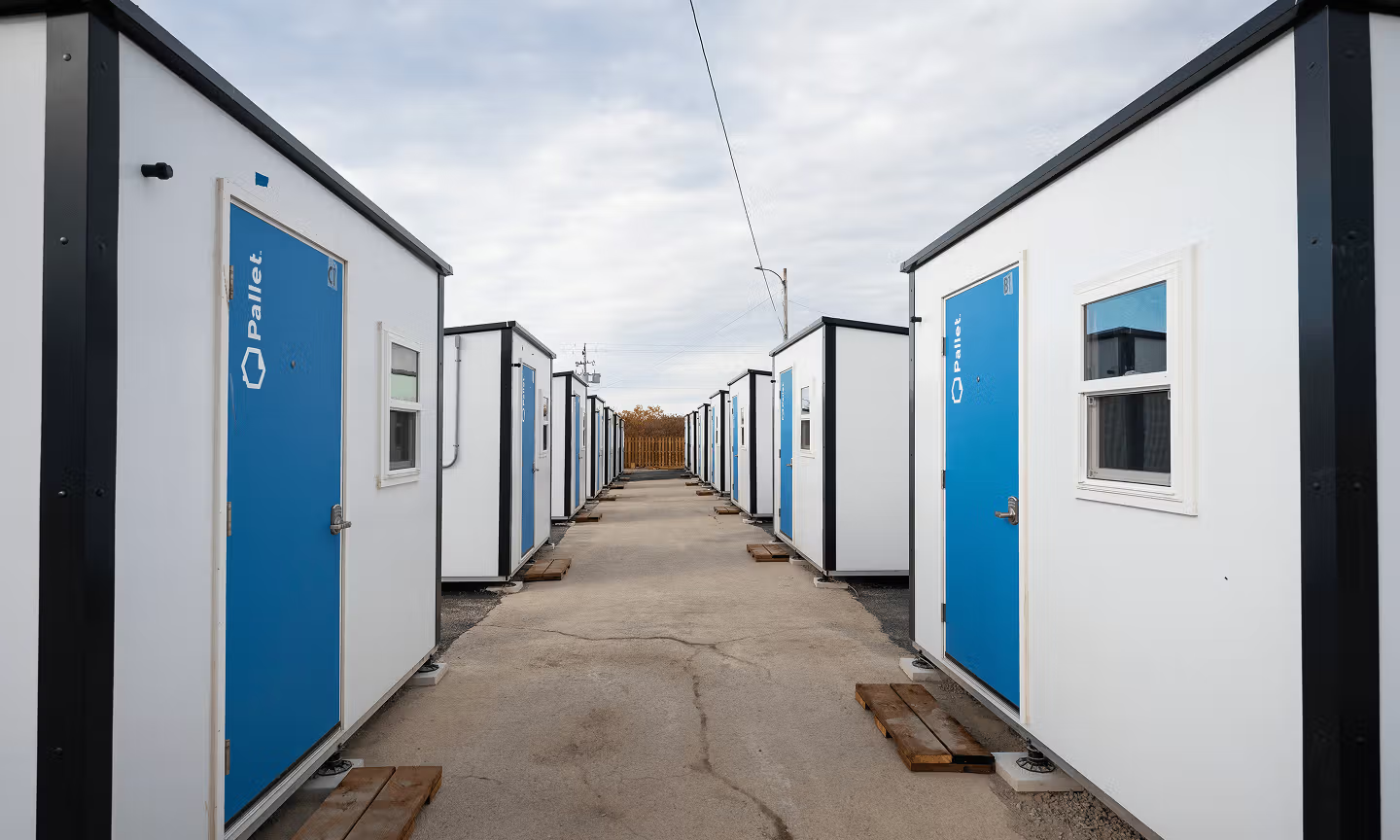
In Sydney, N.S., a “homeless shelter of the future” – a village of 35 mini one-room houses – has sprung up to provide transitional housing.
And across British Columbia, local governments are rewriting zoning laws and reinterpreting building codes to legalize tiny houses on wheels.
Building homes, or parts of homes, in a factory and then assembling them on site has the potential to speed up project timelines and cut costs. Modular construction, also known as prefabrication, is a key element in the federal government’s strategy to roughly double the housing industry’s output to 500,000 starts a year.
Many Canadian communities are charging ahead with their own ideas of how best to apply these promising building methods. Some are even challenging conventional notions of what makes a home a home. Here, we delve into a few of the most original initiatives underway.
The dignity of a locking front door
Cape Breton, Nova Scotia
Seventy-two square feet may seem awfully tiny for a home, but it’s enough for a built-in bed, desk and shelves. And most importantly, a door. When Charles Jackson first opened it a few years ago, he was among the first to move into one of the 35 shelters at the Village at Pine Tree Park on the outskirts of Sydney on Cape Breton Island. “I loved the fact that I had my own little hut that I could stay in and lock the door,” he says. “I had heat. I had power. There was Wi-Fi so I could search the web.”
He settled at Pine Tree after living in his car for five months during the summer and fall of 2024. The 57-year-old father of two had lost his job during the pandemic. The stress exacerbated a chronic health condition, and he had difficulty finding other work. His mental health, and his relationship with his wife of 34 years, deteriorated. She asked him to leave in July that year. He got in his car and drove away, not exactly sure where he was going or what he would do.
Jackson learned that it was safer to sleep during the day. He looked for places that were busy, places with a lot of lights, before it got dark. He often parked at a gas station, one with a sympathetic manager. Jackson got the call about his new place at Pine Tree as the temperature started to drop. “The winter was coming, and so I was … pretty lucky to get into the shelter. I was so grateful. You have no idea.”
Erika Shea, the CEO of New Dawn, the non-profit that built the village, calls Pine Tree the homeless shelter of the future. “One of the reasons why people sleep in tents is they don’t want to go to a congregate shelter,” she says. “They don’t feel safe. They’ve had difficult experiences.” Shea notes that people sleeping in the same room as dozens of other strangers often lie down on top of their belongings because they worry about being robbed.
The simple technology of a door with a lock affords privacy, dignity and security. You can let your guard down, catch your breath. “It’s about helping people get to a place that their minds and nervous systems can even think about what comes next,” Shea notes.
At Pine Tree, a large building next to the orderly rows of white cabins with bright blue doors holds the bathroom and shower facilities, laundry, kitchen and common room with tables and chairs.
The goal is to find people stable, permanent housing within six months. Three support workers from the Ally Centre, a social service agency, are on site at all times. Health professionals visit regularly. Programs include resources for addictions, anger management courses, art therapy and employment services. The province provides a full-time housing support worker.
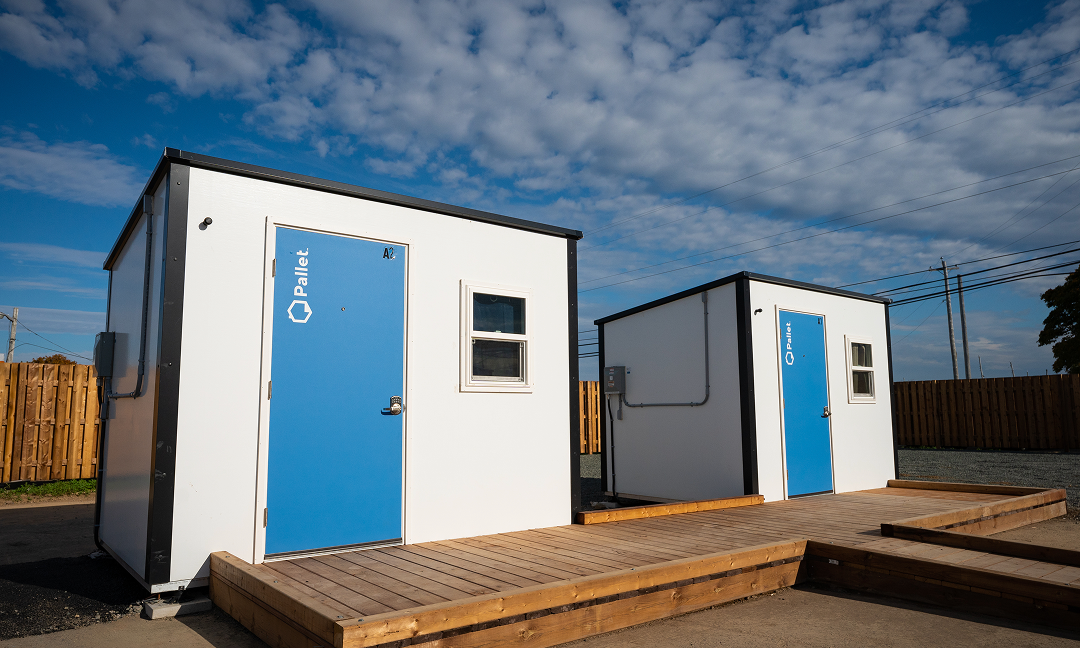
In 2023, the government of Nova Scotia bought 200 of the prefabricated shelters, which can be put up or taken down in less than an hour from U.S. company Pallet, for $7.5 million. Pine Tree is one of six such villages in the province. Shea says homelessness increased dramatically during and after the pandemic. The number of people without homes in the Cape Breton Regional Municipality more than doubled within a few years, from 200 to 500 out of a population of 80,000. “It was the intersection of a growing mental health and addictions crisis and the rising cost of housing, and those things happening simultaneously.”
Sydney is not a big city and people were unfamiliar with that level of visible homelessness. Shea says it’s been a crash course for the community about why this happens and the best ways to address it. Provincial government officials first proposed a location for the shelter village closer to downtown. Shea remembers a heated public meeting in early 2024. “It was clear pretty early on that we were arguing with people’s imaginations. All of the things that they were most scared of we knew were never going to happen.”
Still, paramedics and the police have responded to more calls at Pine Tree since the shelter opened. The village is on an 80-acre property owned by New Dawn that includes a housing facility for people with disabilities, 28 detached homes, a mobile home park and a curling club. “Many of the people who join us at the village are dealing with mental health and addictions difficulties that can make clear thinking and emotional regulation really hard,” Shea says. Staff have learned that they can’t help everybody. There’s a zero-tolerance policy for violence and aggression. Last August, one resident attacked another with a kitchen knife. Both men were evicted. New Dawn runs a Good Neighbours Committee that meets quarterly with the public and in the aftermath of a crisis.
More villages like the one at Pine Tree Park are springing up across the country. The philanthropist Marcel LeBrun and his organization 12 Neighbours have started four in New Brunswick − one in Fredericton and three in Saint John.
The biggest challenge to the success of transitional housing is a shortage of places to move people to after they get back on their feet. Most residents at Pine Tree need some kind of help to live on their own. “More options around long-term supportive housing are, we believe, how we get out of this homelessness crisis,” Shea says. New Dawn opened a 25-unit supportive housing facility in Sydney last May and is building eight tiny homes, larger units with their own kitchens and bathrooms, at Pine Tree Park.
About 110 people have lived in one of the 35 Pallet shelters in the first 18 months of operation. Jackson is one of 50 who found a new residence. He moved into a one-bedroom basement apartment in a house in July 2025. “I got my own doorbell and my own door down below, so it’s private and it’s quiet and it’s clean,” he says. “I loved it the minute I saw it.”
Read the full story by Doug Horner on Be Giant’s website here.


